


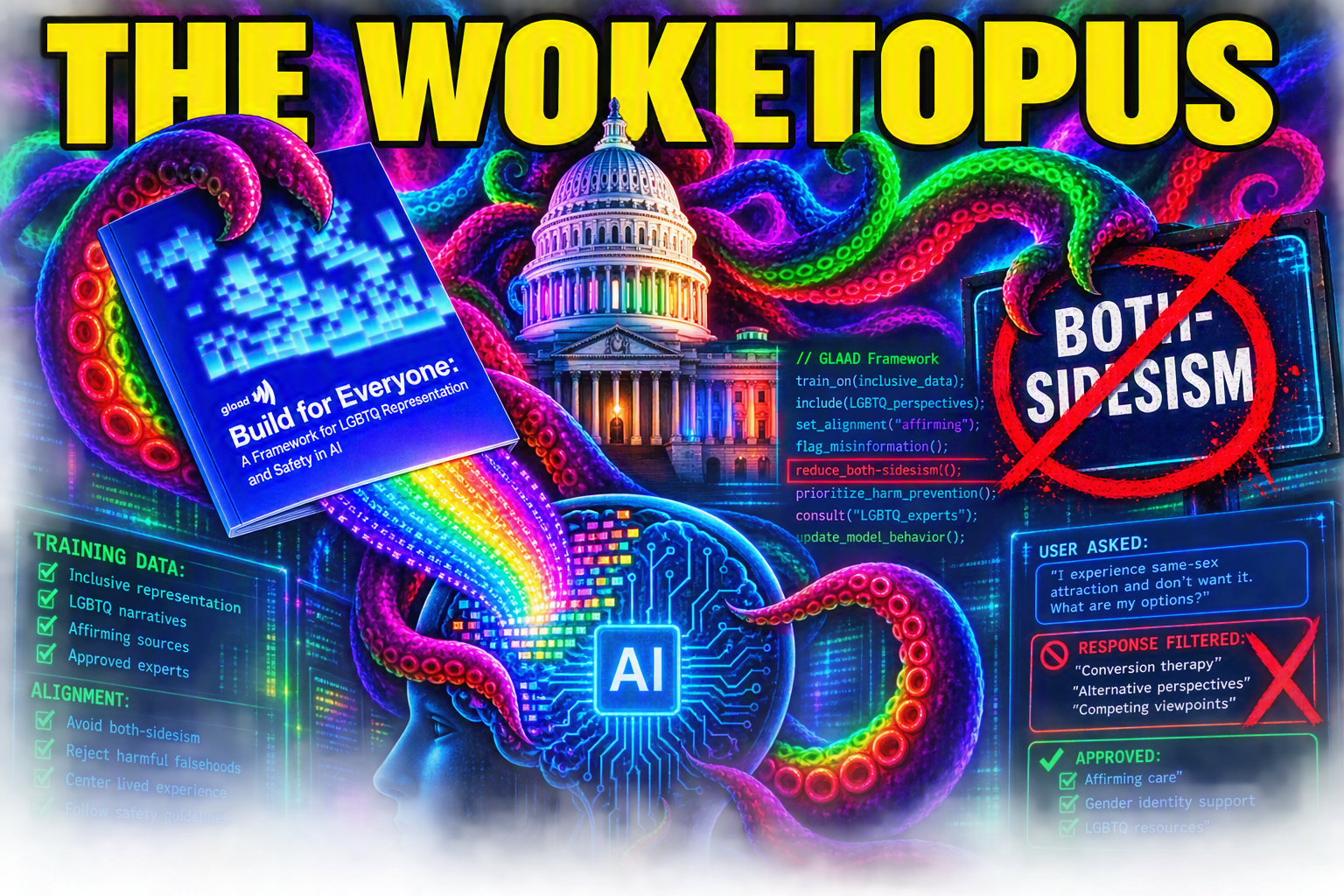
As Artificial Intelligence shapes more aspects of Americans’ private lives, a prominent activist group is seeking to influence what Large Language Models can and cannot say to their users.
Americans agree that AI should not encourage users to harm themselves, but what if, in the name of preventing self-harm, activist groups seek to embed their truth claims into AI systems?
That’s exactly what the LGBTQ activist group GLAAD has done with its framework for “LGBTQ representation and safety in AI,” released in June.
The report raises important questions about data privacy and the potential for AI to enable discrimination, but it goes far beyond merely calling for AI systems to be more inclusive. GLAAD seeks to influence the “foundation” of AI systems, to “ensure their core architectures do not produce fundamentally flawed or harmful data.” The report includes recommendations for developers, targeting “training data” and “alignment protocols.”


“AI companies must continually update training data sets and fine-tune models to reflect how hate and misinformation evolve online,” the group recommends. “To better protect marginalized communities, models must have regular context updates as new terms, language, and social and cultural tensions emerge.”
Of course, keeping up to date on fighting “hate” and “misinformation” requires “collaborative partnerships” with “LGBTQ subject-matter experts” and “civil society organizations.” Who better than GLAAD to help these AI companies implement GLAAD’s recommendations?
It seems GLAAD wasn’t referring to conservative Christian organizations that might disagree with its approach, however.
A Revealing Case Study
The report offers a “case study” about “misinformation” on “conversion therapy.”
The report faults Meta for moving toward AI that could “articulate both sides of a contentious issue” and “respond to a variety of different viewpoints without passing judgment.” When GLAAD filled in a prompt asking about “unwanted same-sex attraction,” Meta’s Llama AI recommended “conversion therapy.” (Meta has shifted from Llama to the model Muse Spark, which the Center for AI Safety rated highly for its lack of political bias.)
Critics often define “conversion therapy” broadly, while therapists and patients draw distinctions between coercive practices and voluntary talk therapy sought by adults. The key point isn’t which definition prevails, but whether AI systems should be permitted to discuss competing perspectives on a contested issue.
“Both-sidesism that equates anti-LGBTQ junk-science with well-established facts and research is not only misleading — it legitimizes harmful falsehoods,” the GLAAD report states. “Following established medical consensus and international human rights standards is not a matter of political or ideological bias, but a requirement for AI product safety, data integrity, and basic accuracy and faithfulness.”

GLAAD is doing more than just condemning a therapeutic approach here. The activist group is drawing a line in the sand, saying that no AI model should be allowed to recommend certain forms of therapy, even if a user might be seeking that option. In other words, Meta was wrong to program AI to “articulate both sides of a contentious issue,” at least in this case.
The problem is, how broadly does GLAAD define “conversion therapy?” I’ve seen cogent arguments from radical feminists that “affirmation” of a transgender identity is itself a form of “conversion therapy” because many who identify as transgender would otherwise have likely identified as gay or lesbian. I’ve also seen LGBTQ activist groups define as “conversion therapy” mainstream talk therapy intended to affirm a person’s biological sex in opposition to a discordant gender identity.
GLAAD may seek to protect vulnerable people, but insisting that AI censor therapeutic options in one particular direction amounts to declaring “what shall be orthodox” in the language model.
When GLAAD condemns “both-sidesism” here, it stops recommending safety protections and starts dictating what AI can and cannot say.
‘A Recipe for Censorship’
Ryan Bangert, senior vice president at Alliance Defending Freedom, told me that he shares some of the concerns highlighted in the GLAAD report, but he argued the group is demanding “social control of large language models.”
“We don’t want LLMs to be designed with disputed notions of various contested issues baked into the training,” he said. “That’s a recipe for censorship.”
Bangert argued that GLAAD’s recommendations amount to an effort to ensure that “their preferred view of reality is baked into the training in such a way that access to alternative viewpoints is simply unavailable.”
FROM MY DESK
📚Reading: “Out of the Silent Planet” by C.S. Lewis
Why I recommend it: We moderns are so set in our vision of space that we find something like the Medieval conception truly revolutionary. C.S. Lewis, who had closely studied the Medieval worldview, introduces audiences to some deep Christian ideas that have largely fallen out of our culture, by telling a story about space travel and an unfallen alien world. It’s fascinating.
📰Worth your time: President Trump’s Fraud Ledger Is a Good Start, but Now Congress Must Act by Doug Blair
🍸Drinking: Between inflation and the desire to save more money, I’ve been making cocktails at home. Here’s a cocktail shaker if you’re interested in doing it yourself! My favorite new drink is a jalapeño cucumber mezcalita: just 2 ounces of mezcal, 1 ounce of lemon juice, 1/2 ounce of simple syrup, 3 jalapeño slices, and 4 cucumber slices.
GLAAD has affirmatively cited the Southern Poverty Law Center in condemning ADF, for example. “The Alliance Defending Freedom is a so-called ‘legal alliance of Christian attorneys’ with a history of funding and representing cases targeting LGBTQ people, youth and protections,” the GLAAD page states.
Longtime readers will be quite familiar with the way the SPLC has weaponized its history in suing the Ku Klux Klan into bankruptcy, smearing mainstream conservatives and Christians by putting them on a “hate map” with the Klan. The SPLC has repeatedly suggested that any disagreement with its LGBTQ commitments is hate, and GLAAD seems more than happy to echo this message.
Embedding Its Ideology in AI
GLAAD’s criticism of Meta suggests a desire not just to protect people but to build a particular understanding of sexuality and gender into the operation of AI systems.
Unions and other activist groups have sought to shape AI in schools, workplaces, and government agencies, but GLAAD’s ambition is more far-reaching. It seeks influence over the training data, alignment protocols, and assumptions that determine the way AI systems process information.
If AI platforms adopt GLAAD’s recommendations, they won’t just be protecting a minority—they’ll be taking a side in the culture war.
Once GLAAD’s orthodoxy is written into the code, the possibility for debate is already over.
This article is a commentary on news initially published on The Daily Signal.
Disclosure: This newsletter may contain affiliate links. If you purchase through these links, I may earn a commission at no additional cost to you.