Arrest of Heidi Beirich Is an Indictment on the 'Anti-Hate' Industry
The first arrest in the case against the Southern Poverty Law Center highlights a deeper problem in America’s “anti-hate” industry.
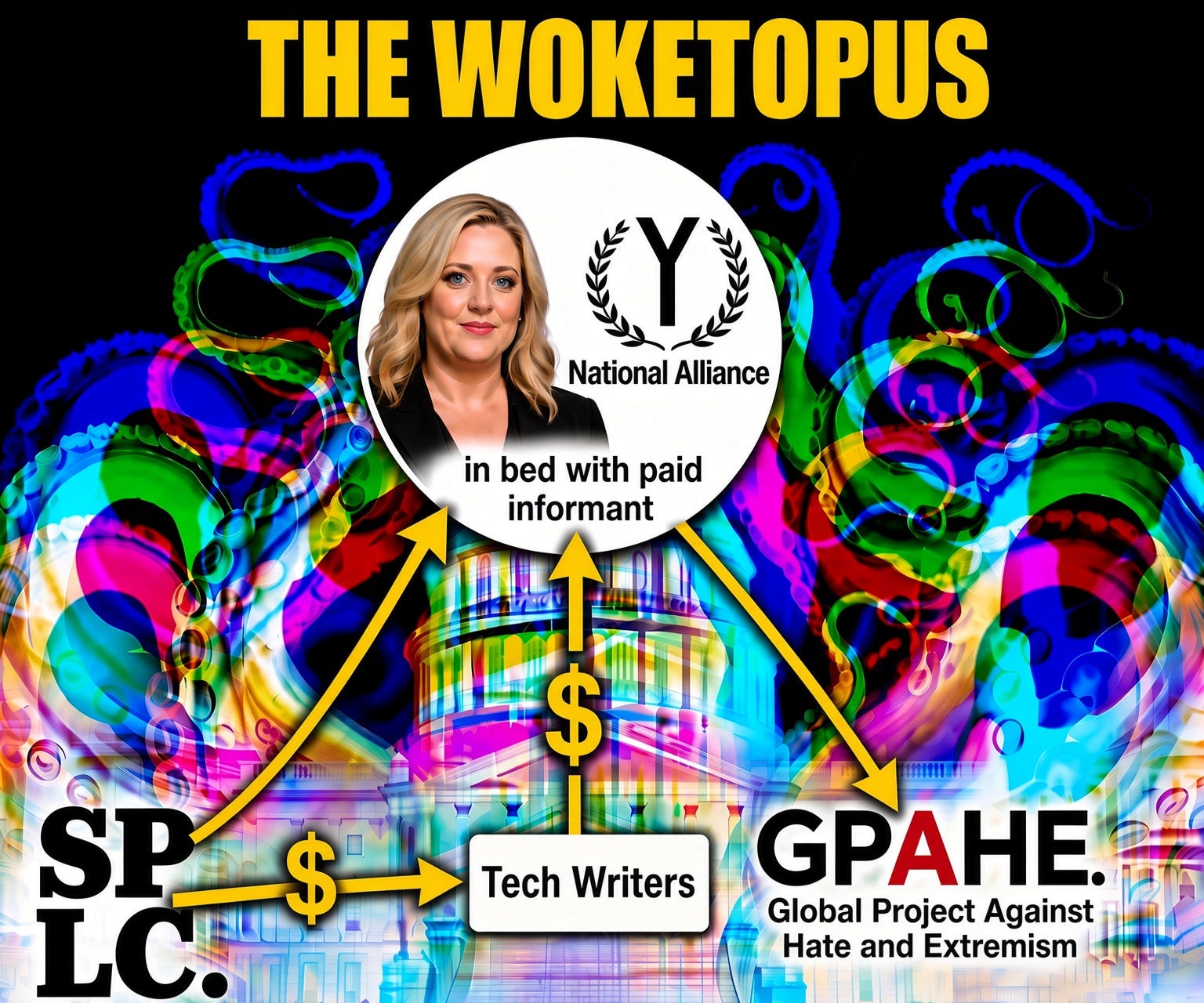
Federal authorities arrested former SPLC leader Heidi Beirich last week, charging her with conspiring to fraudulently funnel cash to white supremacist groups and financing her romantic relationship with a neo-Nazi leader. The seedy details of Beirich allegedly scheming to set up fictitous bank accounts and subsidizing 66% of the couple’s lifestyle on the SPLC’s clandestine dime don’t just make for compelling headlines—they raise important questions about the ecosystem that elevated her to an influential role.
Beirich repeatedly warned about the threats of far right extremism, while ignoring threats from the Left. That ideological imbalance appears not only in organizations like hers but in the institutions that claim the authority to define “hate,” “extremism,” and “misinformation.”
Beirich’s influence spread far beyond the SPLC, and this scandal highlights corruption in more than one institution.
Beirich Arrested
A grand jury handed down an indictment charging Beirich with wire fraud conspiracy, bank fraud conspiracy, and conspiracy to commit concealment money laundering.
Her arrest marked the first in a groundbreaking fraud case against the Southern Poverty Law Center, a left-leaning nonprofit known for bankrupting the Ku Klux Klan in the 1980s and for publishing a “hate map” of extremist organizations that includes mainstream conservative groups alongside Klan chapters.
The SPLC maintained an informant program, paying Klan members to report on violent plans before they took place. Prosecutors allege, however, that the SPLC secretly funneled donor cash to prop up the very hate groups it claims to exist to oppose.
Beirich had managed the SPLC’s “Intelligence Project,” the project behind the “hate map,” for eight years, but she also started a spin-off organization in 2020 called the Global Project Against Hate and Extremism. Through that group, she has contributed to the removal of content on social media and worked with the State Department under President Joe Biden, as well as with foreign governments and major philanthropies, as a supposed gatekeeper on extremism.
Yet, according to a superseding indictment unsealed Wednesday, she had been romantically involved with a member of the neo-Nazi group National Alliance, whom the indictment refers to as “F-9.” Their lifestyle was funded in part with donor money.
“Beirich was also in a relationship with F-9,” the indictment states. “During this relationship, Beirich and F-9 shared a house and two bank accounts.”
“Between 2015 and 2021, approximately $140,000 in donors’ money flowed from the SPLC operating account, through the Tech Writers account, and was ultimately deposited into the joint bank accounts held by F-9 and Beirich,” the indictment states. “This amounted to approximately 66% of all money ever deposited into their joint bank accounts. Beirich then used donors’ money to pay the couple’s personal living expenses.”
These new allegations raise serious concerns about Beirich’s influence and advocacy, which did not stop when she left the SPLC in December 2019.
Beirich’s Group
Big Tech, corporate America, banking institutions, and even the FBI have used the SPLC “hate map,” treating the SPLC as a gatekeeper and arbiter on “hate.” Beirich, along with another former SPLC staffer, led the Global Project Against Hate and Extremism to carve out a similar role for itself.
Like the SPLC, the Global Project Against Hate and Extremism uses a broad brush to define far-right extremism. The group frames opposition to mass immigration and transgender ideology as rooted in “hate,” “white supremacy,” or “Christian nationalism.”
However, the group openly admits that it “does not cover far-left extremism,” claiming far-left groups do not “attack individuals for their identity traits,” do not “advance rights-restricting agendas,” and that “far-left extremist movements have not in recent years engaged in mass violence in the manner that the far-right has.”
Yet GPAHE, like the SPLC, found influential partners in President Joe Biden’s administration.
The group participated in the Biden State Department’s “Summit for Democracy” in 2021.
Beirich testified in Congress that white supremacy is motivating “increasing terrorist threats,” and claimed that “white supremacists are taking up weapons in an attempt to create conditions that will stop the process of demographic change in the Western world.” She called for “more rigorous enforcement procedures” to keep white supremacy out of the military, such as monitoring the online activity of active-duty troops, and “mandatory reports every year about the levels of white supremacy in the military.”
In response to such concerns, the Department of Defense under President Joe Biden ordered a stand-down to address extremism. Yet an independent study on extremism in the military, conducted by the Institute for Defense Analyses at the DOD’s request, found “no evidence that the number of violent extremists in the military is disproportionate to the number of violent extremists in the United States as a whole.”
GPAHE wielded influence not merely in Washington but in the broader censorship ecosystem, joining the Christchurch Call Advisory Network, partnering with major philanthropies, and celebrating content-removal decisions from social-media platforms. Even AI companies, such as Anthropic, have cited GPAHE as an outside expert on extremist content.
The Broader Problem
Secretary of State Marco Rubio hit on the broader problem well in his speech about the threat of leftist terrorism in July.
“We have think tanks and fellowships and journals and consultancies, with the unspoken understanding among them that only one kind of political violence was a true threat to the system,” Rubio said. “A bomb planted by a neo-Nazi group was a nefarious and murderous act of evil. It is. But a bomb planted by a Marxist revolutionary — well, that’s just merely a tragic excess of idealism.”
Rubio argued that “this extraordinary ideological prejudice” grew so bad that “people in positions of power have repeatedly dismissed acts of violence and even terrorism as legitimate forms of political expression so long as they served a left-wing cause.”
Rubio rightly mentioned the George Floyd riots in the summer of 2020, and Americans should well remember the arsons of Teslas last year. Democrats have even defended the invasion of a church in the middle of service as a mere act of protest.
This bias arguably filters down from the universities, where a study from Heterodox Academy highlighted persistent imbalance. A 2016-2017 study in the Heterodox Academy report found that 60% of faculty identified as “liberal” or “far left,” while 28% identified as “middle of the road,” and 12% identified as “conservative.”
A Foundation for Individual Rights and Expression Study in 2024 found that 62% of undergraduate-facing faculty at 55 elite schools identified as Democrat, 13% as Republican, and 24% something else. A 2024 Duke University study found 62% of professors identified themselves as “somewhat liberal” or “very liberal,” 24% as “moderate/centrist,” and 14% as either “somewhat conservative” or “very conservative.”
FROM MY DESK
📚Reading: Rhythm of War by Brandon Sanderson
Why I recommend it: This is the fourth book in Sanderson’s “The Stormlight Archive.” As with many of his books, this one moves slowly at times, but the conclusion more than delivers on the build-up throughout the book.
📰Worth your time: Homelessness Up 20% Under Newsom as Trump Admin Rolls Out ‘Treatment First’ Alternative by Hailey Gomez
🗺️Want to know what’s in the background of some of my TV hits? We have a fantastic world map made out of wood on the wall—and I had a blast putting it up. We ordered the pieces on Amazon, but you get to put it together, and it was a blast.
A 2022 study in the National Library of Medicine found that scientists are “more politically liberal than the general population,” and the trend holds true for employees of the academic sector generally, and even for scientists employed in the energy sector.
NewsNation host Batya Ungar-Sargon analyzed the data from the University of Cincinnati’s Prosecution Project—one of the legacy media’s favorite sources for claiming that most political violence comes from “the Right”—and found glaring omissions when it came to leftist political violence. The project did not mention the assassination attempts against President Donald Trump, the assassination of Turning Point USA founder Charlie Kirk, nor the George Floyd riots of 2020. Meanwhile, it exaggerated examples of “right-wing political violence.”
Tying It All Together
Beirich’s alleged scheme to clandestinely pay the Klan and her alleged relationship with a neo-Nazi informant are shocking anecdotes, but they highlight a much more serious problem.
The issue is not merely that Beirich occupied a prominent role. The problem is that institutions increasingly outsourced their judgment to organizations such as SPLC and GPAHE. Tech companies, government agencies, philanthropies, journalists, and researchers often treat a small network of activist organizations as authoritative arbiters of who counts as too hateful or extremist for polite society.
This case should inspire some deep soul-searching among America’s “elite,” and should spur efforts to address deep-seeded institutional bias.
Large portions of this article were initially published on The Daily Signal.
Disclosure: This newsletter may contain affiliate links. If you purchase through these links, I may earn a commission at no additional cost to you.


