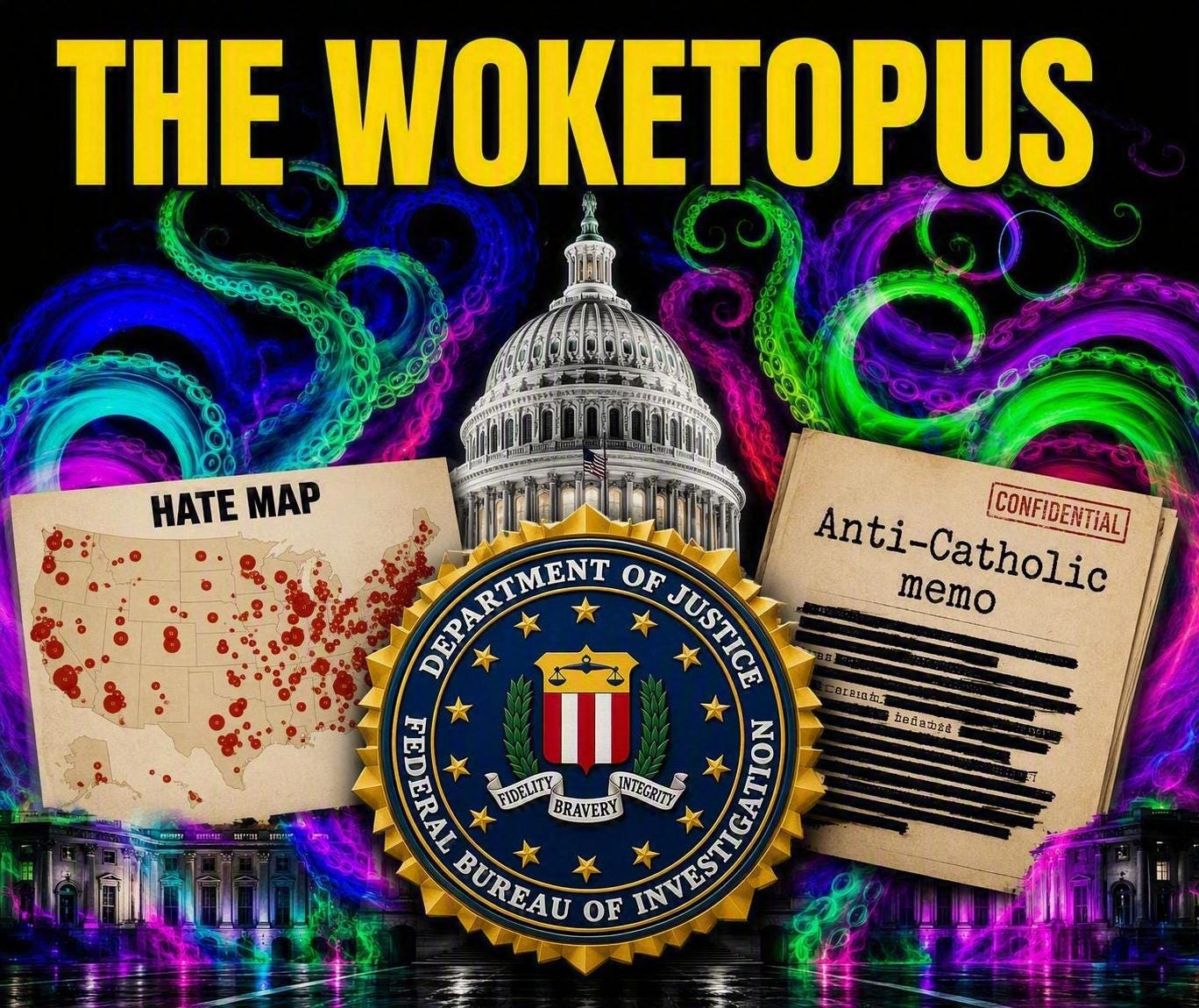
Americans were rightly outraged to see the FBI publish a memo claiming a nexus between racially-motivated violent extremists and “radical traditional Catholics,” but that memo merely represented one piece of an anti-Christian group’s influence on the bureau.
The anti-Catholic memo wasn’t just a scandal because it attacked Catholics—it also reveals a longstanding relationship between a premier law enforcement agency and an organization that systemically demonizes conservative Christians.
The Weaponization Working Group in President Donald Trump’s Justice Department released a report last week, exposing that the FBI cited that anti-Christian group more than 22,000 times.
The FBI Memo
The Richmond office of the FBI published the notorious memo on Jan. 23, 2023, claiming that “racially-motivated violent extremists” were seeking to recruit “radical traditional Catholics.”
The memo cited the Southern Poverty Law Center, a public interest law firm that has long since transformed into a far-left smear factory. The SPLC established its reputation by suing Ku Klux Klan groups into bankruptcy, but when it ran out of Grand Dragons to slay, it turned to ever-more-mainstream groups. Today, it puts mainstream conservative and Christian organizations on a “hate map” with the Klan.
The memo didn’t just cite the SPLC, it did so without any caveats about the SPLC’s questionable credibility.
The FBI publicly retracted the Richmond Catholic memo one day after it leaked, and a newly disclosed Feb. 21, 2023, Analytic Tradecraft Review explains why.
Among other things, the tradecraft review faults the memo for failing to “provide any details regarding any potential bias/credibility of the sources, including concerning SPLC.”
The review notes that the SPLC “is an important resource for the FBI because it centrally locates hate crime information and data the FBI might not otherwise be privy to.” Yet “the SPLC has a history of having to issue apologies and retract groups and individuals they have identified as being extremist or hate groups.”
When it comes to the Richmond Catholic memo, “since this was reporting on a religious branch of Catholicism that SPLC identified as a hate group, there should have been extra care to caveat the information, which was more subjective than statistical, and examine SPLC’s threshold for determining a hate group and explain how it aligns or differs from the FBI’s definition,” the review states.
Twenty-Two Thousand References
The Weaponization Working Group reported that Richmond FBI leadership nevertheless ignored directives to “admonish” the memo’s authors and instead gave them positive performance reviews.
A March 1, 2023, email includes “talking points” for Richmond Special Agent in Charge Stanley Meador (now secretary of public safety under Virginia Gov. Abigail Spanberger).
The analyst searched the case management system Sentinel, finding 9,040 references to “SPLC” and 13,250 references to “Southern Poverty Law Center.”
Even accounting for overlap among the search results, the totals reveal the SPLC’s substantial footprint at the FBI. The SPLC has explicitly stated that it “did not provide any information or communicate with any FBI personnel involved in preparing this Richmond Field Office memo,” but it did not have to directly provide information for the FBI to cite its reports.
The analyst flagged 12 reports from January 2022 to January 2023 that cited the SPLC “with no caveated language,” though the email does not say how many reports the analyst reviewed.
Why do caveats matter?
Every law enforcement agency relies on outside sources, and the SPLC provides information others do not. When FBI reports cite the SPLC without warning readers about the group’s longstanding bias and repeated retractions, however, they implicitly elevate it from an advocacy group to an authoritative expert.
Critics have long challenged the SPLC’s credibility, arguing that it inflates the threat of hate by falsely branding mainstream groups extreme. Those concerns intensified this year when prosecutors brought criminal charges against the organization and a former top official, alleging that the organization clandestinely funded hateful activity while raising money on combatting hate.
Anti-Christian Bias
But is the SPLC anti-Christian? The organization’s own words condemn it.
When critics called the SPLC “anti-Christian,” the organization offered a response:
A major misconception—one that is deliberately promoted by anti-LGBT hate groups in order to accuse the SPLC of being “anti-Christian”—is that the SPLC considers opposition to same-sex marriage or the belief that homosexuality is a sin as the sole basis for the hate group label. This is false. There are many organizations, such as Focus on the Family, that oppose same-sex marriage or oppose homosexuality on strictly Biblical grounds that the SPLC does not list as hate groups.
The only concrete evidence the SPLC presented to prove that it wasn’t anti-Christian was the decision not to place Focus on the Family, the oldest and most recognizable non-church Christian nonprofit, on the “hate map.”
That argument no longer works.
This response to the “anti-Christian” charge disappeared from the SPLC’s website, and last year, the SPLC added Focus on the Family to the “hate map.”
R.G. Cravens, a senior research analyst at the SPLC, defended putting Focus on the map. “Like other hate groups that SPLC lists, they weaponize Christian rhetoric against LGBTQ+ people,” he said. “They sow division and ideas that tear families apart by perpetuating political notions that LGBTQ people can’t be, for example, truly Christian unless they deny who they are.”
“That’s one, just patently false, and two, it’s really dangerous,” Cravens argued.
Cravens’ position stands in opposition to the Bible and orthodox Christian tradition, which teach that sex should be reserved for marriage between one man and one woman, and that Christians must repent of sin, not identify with it. Christian doctrine does not say that people who experience same-sex attraction or gender dysphoria cannot accept the gospel and become Christian, but identifying with sinful desires is not compatible with the traditional understanding of repentance.
By taking this position, the SPLC is equating traditional Christian doctrine with hate.
That’s not just my opinion. The SPLC took a direct quote from the Catechism of the Catholic Church, the binding statement of faith for 1 billion people, as evidence of “hate.”
In its “extremist file” on the Ruth Institute, the SPLC cites this statement from Jennifer Roback Morse, the conservative nonprofit’s founder: “The church is very clear that same-sex sexual acts are intrinsically disordered and can never be morally acceptable.”
Morse didn’t come up with that herself—it’s a statement directly from the Catechism.
The issue is not that the SPLC disagrees with traditional Christian teaching—it has every right to do so. The issue is that it increasingly treats adherence to that teaching as evidence of extremism.
FROM MY DESK
📚Reading: Grant by Ron Chernow
Why I recommend it: Ulysses S. Grant is one of America’s under-appreciated presidents, and this book helps explain why. While some condemned him as a butcher, he was essential for the Union’s victory in the Civil War, and he governed at a particularly tumultuous time.
📰Worth your time: After Years of High-Profile Probes, James Comer Eyes a New Political Prize by Fred Lucas
🗺️One of my favorite things in our house is the fantastic world map made out of wood on the wall—and I had a blast putting it up.
Despite this anti-Christian bias, the FBI not only cited the SPLC 22,000 times, but compiled at least twelve reports in the year before the anti-Catholic memo—reports that cited the SPLC without any caveats on its bias or credibility. This also came at a time when the SPLC maintained close ties to the Biden Justice Department’s Civil Rights Division, and Cravens was briefing DOJ prosecutors on the “anti-LGBTQ movement.”
The SPLC’s longstanding practice of putting conservative Christian groups on the “hate map” even led to a terrorist attack. Floyd Lee Corkins II attempted to carry out a terrorist attack at the Family Research Council in 2012. After he was foiled, he told the FBI that used the SPLC’s materials to find the conservative Christian nonprofit, and that he had intended to kill everyone in the building. He pleaded guilty to terrorism charges and a judge sentenced him to 25 years in prison.
FBI Director Kash Patel has severed the FBI’s connection to the SPLC, and President Trump has renewed scrutiny toward anti-Christian bias in the federal government.
The Richmond memo became a national controversy because it targeted traditional Catholics. The newly released records reveal a deeper concern: the bureau’s reliance on an organization that increasingly treats orthodox Christianity itself as suspect. If the FBI is going to use outside sources to understand religious communities, Americans should insist that those sources be credible, transparent, and free from ideological hostility toward the faiths they claim to analyze.
Large portions of this article were initially published on The Daily Signal.
Disclosure: This newsletter may contain affiliate links. If you purchase through these links, I may earn a commission at no additional cost to you.


