


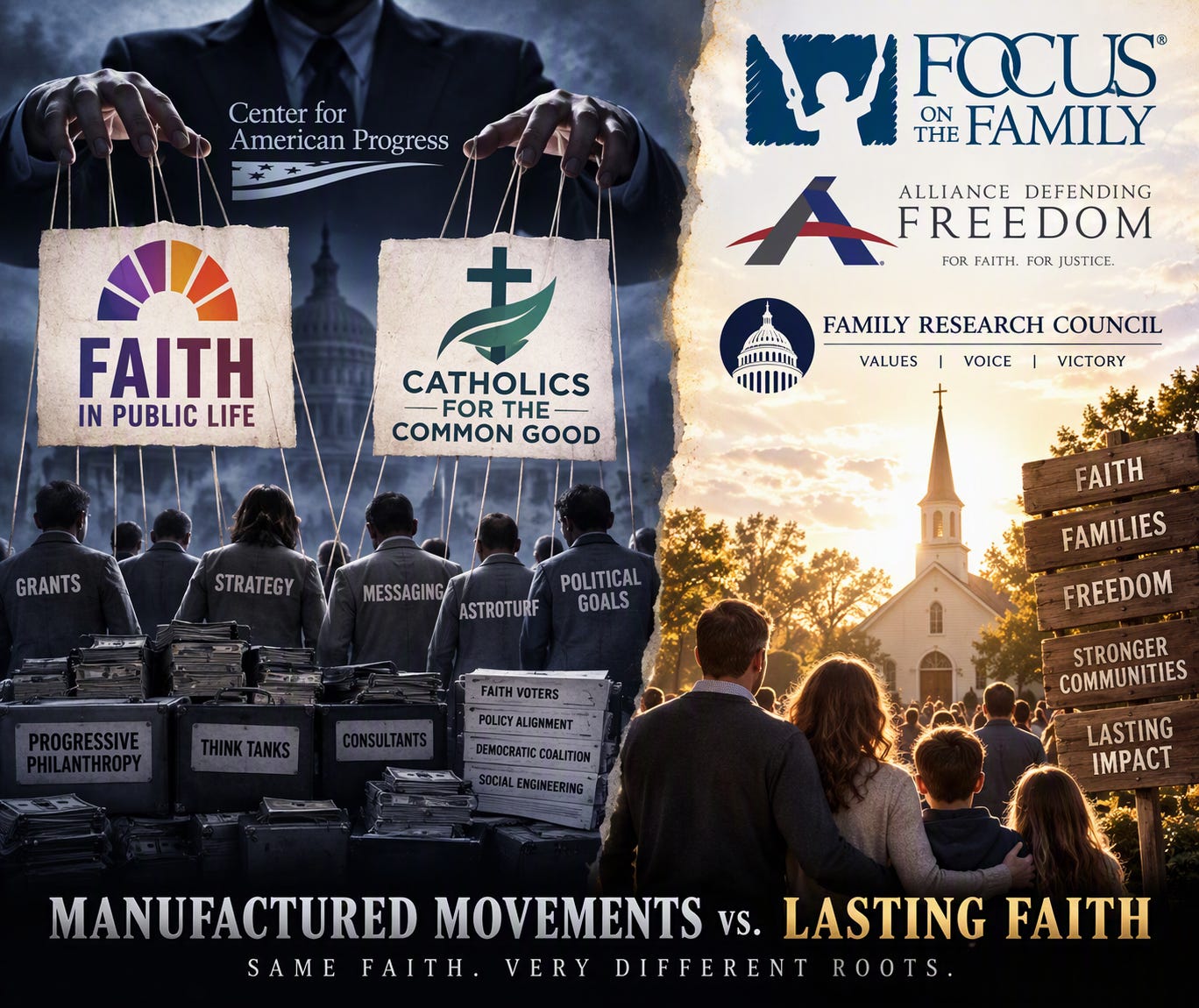
Every now and then, legacy media outlets predict that the Religious Left is rising in opposition to the Religious Right, suggesting that a movement for big-government “compassion” will redefine the face of faith-based politics in America.
Yet these movements fizzle out, while conservative Christianity remains steadfast.
The nonprofit Faith in Public Life has become the latest example of this trend. Launched in 2005 and envisioned as “a sort of organizational anchor for the Religious Left,” Faith and Public Life will be closing its doors at the end of October, because fundraising opportunites have become “inconsistent.”
Faith in Public Life organized a Compassion Forum featuring Barack Obama and Hillary Clinton in 2008, and helped organize support for Obamacare as the “Affordable Care Act” passed through Congress.
The organization also launched the political career of Jennifer Butler, a minister in the left-leaning Presbyterian Church (USA), who founded the group in 2005 and served as its executive director until July 2023. Obama named Butler to an advisory council in 2015, and Vice President Kamala Harris’ campaign hired her as its national faith engagement director.
Faith in Public… Astroturf?
Faith in Public Life didn’t grow out of a grassroots religious revival. Powerful organizations on the Left helped launch and sustain this alternative to the Religious Right.
John Podesta, who served as White House chief of staff to President Bill Clinton, founded the Center for American Progress in 2003, aiming to create a Democrat version of the Heritage Foundation.
“The Center for American Progress was proud to participate in the creation of Faith in Public Life in 2005 and to support the organization and its important work,” Guthrie Graves-Fitzsimmons, a senior fellow at the center, told the Daily Signal last week.
Why would Podesta want to found a Religious Left organization in 2005? President George W. Bush had just defeated John Kerry, buoyed in large part by conservative Christians.
The Center for American Progress reportedly envisioned Faith in Public Life as “a sort of organizational anchor for the Religious Left, a strategy hub that would coordinate disparate groups and develop overarching media strategies for campaigns.”
Hungarian American billionaire George Soros’ Open Society Foundations gave more than $2 million to the group from 2017 to 2021.
A Catholic Spring?
Podesta had also suggested that he helped to found another left-leaning Christian organization in order to launch a “Catholic Spring” similar to the Arab Spring.
Sandy Newman, president and founder of the nonprofit Voices for Progress, wrote to Podesta in February 2012 that “there needs to be a Catholic Spring, in which Catholics themselves demand the end of a middle ages dictatorship and the beginning of a little democracy and respect for gender equality in the Catholic Church.”
“We created Catholics in Alliance for the Common Good to organize for a movement like this,” he replied. Catholics in Alliance for the Common Good, which reportedly received at least $450,000 from Soros’ Open Society Institute from 2006 to 2010, dissolved in 2017.
“We remember the previous scandal that was revealed 10 years ago—when John Podesta wanted to create a ‘Catholic spring’ in which Catholics would revolt against the priests and bishops of their own Church,” Josh Mercer, co-founder and vice president of advocacy at CatholicVote, told the Daily Signal. “Groups like these are not authentically Catholic but explicitly created to manipulate believers.”
“While news that Faith in Public Life is finally folding is welcome, there are still plenty of other deceitful operators out there,” he warned. “They pose as Christians to push decidedly un-Christian agendas on a well-meaning and unsuspecting faithful.”
“There is still a lot of work to do before this cottage industry posts a ‘going out of business’ sign,” Mercer concluded.
Faith in Public Life is folding, but the organization’s founder, Jennifer Butler, has founded another organization. Faith in Democracy seems a clear echo of Butler’s previous nonprofit, as the group aims to “resist the religious right, confront religious nationalism, and defend democracy against authoritarianism.”
FROM MY DESK
📚Reading: “The Apostate: My Search for Truth” by Mark Christian
I had the pleasure of meeting Mark Christian at the Eagle Forum summit this past weekend, and I’ve started reading his autobiography. It’s harrowing and revealing—he grew up as the son of a Muslim Brotherhood leader in Egypt, only to reject Islam and face an assassination attempt from his own father.
📰Worth your time: Open Prostitution Booms in NYC. It’s All Part of the Socialist Plan by Jarrett Stepman
🧼Washing: I’ve been thoroughly enjoying Dr. Squatch’s Mango Tango soap—the spicy-and-sweet scent is invigorating, and the soap cleans and lathers well.
What About the Religious Right?
Meanwhile, organizations on the Religious Right have persisted for decades, and show little sign of closing. Focus on the Family, Alliance Defending Freedom, and the Family Research Council remain active after decades, and even the Southern Poverty Law Center’s decision to put them on a “hate map” hasn’t led them to throw in the towel.
Why this mismatch?
Focus on the Family, Alliance Defending Freedom, and the Family Research Council were not conceived in Washington think tanks as efforts to replicate an existing political movement. They emerged more organically from pre-existing constituencies: churches, pastors, homeschooling families, pro-life advocates, and religious conservatives.
The Religious Left arguably has at least one more organic nonprofit: Sojourners. Unlike Faith in Public Life or Catholics in Alliance for the Common Good, Sojourners started when a group of students at Trinity Evangelical Divinity School formed an intentional Christian community in the early 1970s around concerns about the Vietnam War and social justice. Unlike Faith in Public Life, Sojourners shows no signs of closing anytime soon.
As a conservative Christian, I tend to think that the Religious Right has an edge on the Religious Left because the Left has drifted away from orthodox Christianity and toward ideologies that align with Secular Humanism.
As a journalist, however, I see Faith in Public Life and Catholics in Alliance for the Common Good as fundamentally different from Focus on the Family, Alliance Defending Freedom, the Family Research Council, and even Sojourners.
More than two decades after Democratic strategists set out to build an institutional counterpart to the Religious Right, Faith in Public Life is closing its doors and Catholics in Alliance for the Common Good is gone.
John Podesta’s failed experiments don’t illustrate that there is no constituency on the Religious Left, but they do suggest that authentic religious movements are difficult to engineer from the top down.
The Left can pour money into its nonprofit apparatus. It can select charismatic leaders. It can organize activists who are sympathetic to its message.
But it can’t build a Religious Left out of thin air.
Enduring faith movements don’t begin in boardrooms. They begin with true believers.
This article is a commentary on news initially published on The Daily Signal.
Disclosure: This newsletter may contain affiliate links. If you purchase through these links, I may earn a commission at no additional cost to you.