Even Microsoft Is Distancing Itself From the SPLC
The Left’s enforcer of diversity, equity, and inclusion is bleeding support in corporate America.
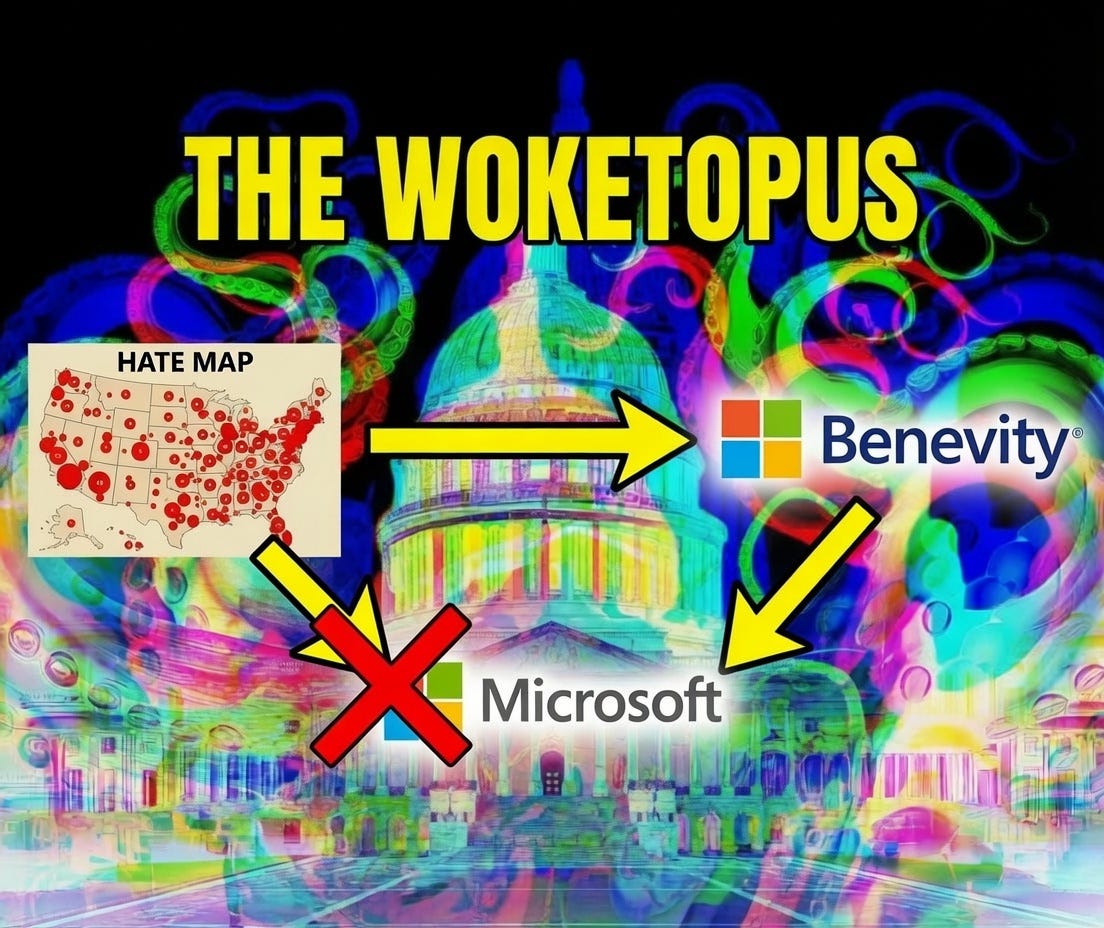
Even Microsoft, the Big Tech company with the fourth-largest market capitalization in the world and the engine behind Bill Gates’ fabulous wealth, has stopped using the Southern Poverty Law Center’s “hate map” to screen nonprofits for its employee matching gift program.
It may sound like a small change, but it marks an important inflection point as companies move back toward neutral. Many companies adopted the SPLC “hate map” as a kind of litmus test to determine which nonprofits don’t count as truly charitable. The SPLC gained its reputation suing Ku Klux Klan groups into bankruptcy, but now it puts mainstream conservatives on the map with Klan chapters.
How do you get on the map? Often by opposing the SPLC’s DEI agenda. Let’s take Do No Harm, for example. The group, led by doctors, opposes transgender medical experiments often euphemistically called “gender-affirming care.” The SPLC calls Do No Harm a “hate group.” Moms for Liberty, a parental rights organization that opposes divisive racial lessons in school is an “antigovernment extremist group.” Even Focus on the Family now appears on the map.
Microsoft’s decision directly affects the company’s 228,000 employees, allowing them to direct the company’s matching grants toward conservative nonprofits.
It also constitutes one more chink in the SPLC’s armor.
‘Major Victory’
“Microsoft’s decision is a major victory against ideological blacklisting in employee gift-matching programs and an important win for conservative and religious organizations,” Tim Schwarzenberger, director of corporate engagement at Inspire Investing, told the Daily Signal.
According to a report exclusively provided first to the Daily Signal, Microsoft disclosed the move away from the SPLC in response to a shareholder proposal.
Inspire Investing, a Christian financial adviser that focuses on “Biblically Responsible Investing,” had filed a shareholder proposal asking Microsoft to evaluate the risks associated with excluding religious organizations from its employee gift-matching program and the use of third-party ideological screening.
“During engagement, Microsoft confirmed that it had removed the SPLC filter from its Benevity platform in late 2025,” the report states. “As a result, otherwise eligible IRS-recognized 501(c)(3) organizations are no longer subject to that additional ideological screening within Microsoft’s employee gift-matching program.”
IWP Capital, a financial advisory firm, also filed a shareholder resolution addressing the issue, on behalf of its client, the Diocese of Fort Worth, Texas.
“We were very grateful to learn of Microsoft’s decision to drop the SPLC screen and allow any legitimate 501(c)(3) to be part of the matching program,” Pia de Solenni, vice president of corporate engagement at IWP Capital, told the Daily Signal in a statement Friday. “Microsoft’s decision allows employees to support religious charities on an equal footing with secular charities.”
She argued that the move benefits both employees and shareholders “by marking Microsoft as a workplace that values the highest level of talent, regardless of political beliefs.” De Solenni also expressed hope that more companies would follow Microsoft’s lead.
SPLC Backlash
The SPLC “hate map” conflates mainstream conservative and Christian organizations with genuinely extremist groups. The SPLC uses it to demonize its political and ideological opponents and to inflate “hate” to scare donors into ponying up cash.
In 2012, a since-convicted terrorist told the FBI he used the SPLC’s map to target the Family Research Council in an attempted mass shooting. The SPLC condemned the attack but kept the council on the map.
FBI Director Kash Patel officially cut the bureau’s ties with the SPLC following the assassination of Charlie Kirk.
In April, a federal grand jury indicted the SPLC for wire fraud and bank fraud for allegedly funneling money to Klan members, propping up the hate threat in order to raise money by claiming to oppose it. The SPLC says the payments involved informants identifying threats, but prosecutors dispute that claim.
1792 Exchange, a nonprofit dedicated to bringing ideological balance back to public companies, and Alliance Defending Freedom called on corporate generosity platforms to stop using the SPLC.
What Is Benevity?
Corporate generosity platforms such as Benevity connect employers to a host of nonprofits. Benevity connects “nearly 1,000 enterprise companies” to a network of 513,000 nonprofits. Benevity acknowledged in 2021 that it uses the SPLC to vet almost “2 million nonprofits.”
Benevity maintains that the SPLC “hate map” is an optional filter, not a default setting.
Thanks to shareholder activism from 1792 Exchange, Bowyer Research, The Heritage Foundation, IWP Capital, and others, a growing list of companies has directed Benevity to stop using the SPLC. The list includes American Express, AT&T, Citi, Mastercard, McDonald’s, Nvidia, and Salesforce.
Companies use other corporate generosity programs as well and have directed them to stop using the SPLC list.
DoorDash directed the platform Deed to stop using the SPLC for this purpose. Verizon directed CyberGrants, another such platform, to stop using the SPLC for its employee giving.
Implications of Microsoft’s Decision
Schwarzenberger, the Inspire Investing director, told the Daily Signal that Microsoft’s decision “demonstrates that even one of the world’s largest companies can administer its employee gift-matching program using objective charitable standards without relying on additional ideological screening imposed by outside advocacy organizations.”
He also noted that Microsoft is “part of a broader trend we’ve seen across corporate America as companies reevaluate employee gift matching, strengthen charitable neutrality, and give employees greater freedom to support lawful IRS-recognized charities consistent with their convictions.”
FROM MY DESK
📚Reading: The Way of Kings by Brandon Sanderson
Why I recommend it: Do you love fantasy series like “The Lord of the Rings?” Do you want something more clean than most fiction these days? Brandon Sanderson doesn’t just do worldbuilding well—he knows how to stick the landing of a medieval fantasy story. This first entry into the Stormlight Archive is long, but the ending is very much worth it.
📰Worth your time: The Cold War Never Ended. It Just Came Home. by Rep. Lisa McClain
🎲Playing: Sushi Go: Party! is a fun card game—easy to learn for many ages and quick to play. The sushi theme makes it very approachable, and it has just enough strategy to engage your brain without making the fun overly complicated.
This trend “has the potential to redirect millions of dollars in matching gifts to otherwise eligible charitable organizations that may have previously been excluded under additional ideological screening criteria.”
Schwarzenberger said he hopes Microsoft’s “leadership encourages others across corporate America to do the same.”
These moves do seem to mark a sea change in corporate America, but companies like Benevity should start rethinking the overall policy. If so many companies start asking to drop the SPLC filter, at what point will Benevity finally be shamed into retiring the option altogether?
Large portions of this article were originally published on the Daily Signal.
Disclosure: This newsletter may contain affiliate links. If you purchase through these links, I may earn a commission at no additional cost to you.


