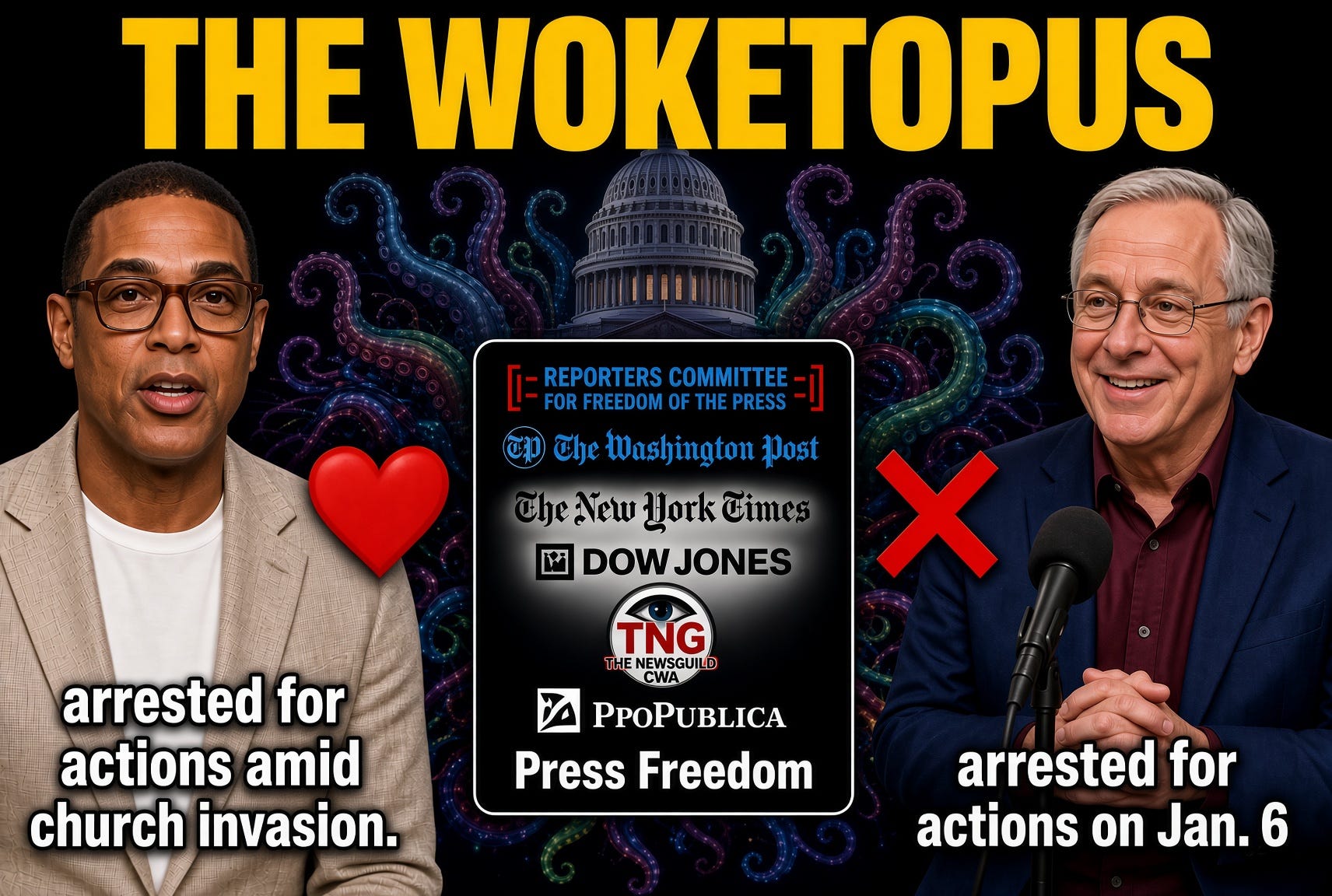
Does freedom of the press only apply to one side of the aisle?
A large group of press freedom groups, news outlets, and watchdog organizations have raised the alarm about criminal charges against former CNN host Don Lemon for his alleged role in a church invasion. They warn that the case might “muzzle reporting in the public interest,” by sending the signal that attempts to cover protests may lead to criminal charges.
Yet these groups didn’t raise a peep when Steve Baker, a reporter with The Blaze, faced criminal charges for filming video inside the U.S. Capitol on Jan. 6, 2021.
Like Lemon, Baker argued he had been documenting an event of major public interest, rather than participating in unlawful conduct.
I reached out to the groups opposing the charges against Lemon, asking if they took any actions to help Baker, and most of them didn’t even respond.
“No legacy media or groups came to my defense,” Baker told me.
The uneven media response to another major story illustrates why I pay close attention to these coverage patterns.
Who Covered the Heidi Beirich Arrest and How?
I’ve covered the corruption of the Southern Poverty Law Center for years, emphasizing how it exaggerates hate by smearing conservatives. So, when the SPLC faced federal fraud charges for allegedly secretly funding the very hate it claims it exists to oppose, it didn’t exactly surprise me.
What has surprised me, however, is just how quick the left-leaning media has been to dismiss the claims in the indictments. When analyzing news coverage, I find Ground News an excellent resource.
Ground News is a website and app that aims to make reading the news easier and more data-driven. Ground News gathers thousands of articles and organizes them by story. Each story comes with visual breakdowns of the reporting bias, reliability, and ownership of each outlet that covered a story.
For example, Ground News enabled me to pull up the bias distribution of the news outlets covering the arrest of Heidi Beirich, the SPLC’s former CFO, last week. Left-leaning media sources haven’t completely ignored the story.
Yet, when left-leaning outlets covered it, they often focused on Beirich’s expertise and dismissed the charges as “malicious,” as Above the Law did here:
Meanwhile, my fellow conservative media outlets have leaned in on the sordid details about Beirich’s alleged relationship with one of the SPLC’s paid informants in a neo-Nazi group.
Ground News includes many excellent tools to analyze news coverage, so you know the factors that shape the narrative. I am partnering with Ground News because ot its dedication to exposing bias and educating readers and subscribers, so they can get a better understanding of the story behind the story.
Subscribe to get 40% off the unlimited access Vantage plan today using my link groundnews.com/woke or by clicking the button below.
Whether I’m researching the SPLC, Don Lemon, or any other controversy, I find Ground News helpful for understanding which outlets are covering a story and how that coverage differs across the political spectrum.
The Don Lemon Case
Forty-five media outlets and nonprofit organizations joined an amicus brief asking a federal court to dismiss the church invasion charges against Lemon and independent journalist Georgia Fort.
The Reporters Committee for Freedom of the Press led the amicus brief. News outlets like The Associated Press, Dow Jones (which owns The Wall Street Journal), MS NOW, The New York Times, Slate, and The Washington Post joined the brief, as did the union NewsGuild and nonprofits PEN America and ProPublica.
Lemon and Fort stand accused of violating federal civil rights laws for their alleged activity in the invasion of Cities Church in St. Paul, Minnesota, on Jan. 18, protesting the pastor who works for Immigration and Customs Enforcement.
The Justice Department brought charges against Lemon and Fort under the Freedom of Access to Clinic Entrances Act and the Ku Klux Klan Act, claiming they took part in the agitation that violated congregants’ civil rights. Lemon and Fort have said they were present at the invasion in their capacity as journalists.
The amicus brief argues that if Lemon and Fort are convicted, “federal law would be within arm’s reach of prosecutors to muzzle reporting in the public interest.” Magistrate Judge Douglas Micko of the U.S. District of Minnesota added the brief to the court record Monday.
The News Outlets’ Argument
The brief notes that both the FACE Act and the Ku Klux Klan Act require prosecutors to prove that defendants intended to violate Americans’ rights.
“Journalists intending to cover a story lack the specific intent to deprive individuals of a clearly defined right” under the laws and “therefore cannot be held criminally liable,” the brief notes.
If the judge allows the case to proceed against Lemon and Fort, the brief argues, “prosecutors would be able to use the statutes’ broad and vague language to target journalists who question witnesses in public spaces – activity that is unquestionably protected under the First Amendment.”
The Prosecution’s Claims Against Lemon and Fort
The superseding indictment, filed in February, alleges that Lemon and Fort joined a conspiracy to violate churchgoers’ civil rights.
Agitators, who said they targeted Cities Church because one of its pastors works for Immigration and Customs Enforcement, allegedly stood up in the middle of a service, refused to leave when asked, blocked members of the congregation from getting to their children, and chanted, “Who shut this down? We shut this down!”
The indictment notes that Lemon livestreamed the planning meeting before the church takeover, but he told his audience he was leaving out key details to avoid revealing the target beforehand. It also claims Lemon said “the whole point” of the activity was “to disrupt” the service. It further accuses Lemon of confronting the church’s pastor, refusing to leave when asked, and obstructing churchgoers as they left the building.
The indictment presents fewer concrete claims about Fort’s alleged involvement in the agitation. It alleges that she confronted the pastor and that she blocked a minivan from leaving the church’s parking lot by conducting an interview in front of it.
First Amendment Defense?
Lemon has filed three motions to dismiss the case, citing the First Amendment, claiming that prosecutors engaged in vindictive prosecution against him, and arguing that the FACE Act’s provision protecting houses of worship is unconstitutional.
“Don Lemon has made a mockery of the First Amendment,” Renee Carlson, general counsel at True North Legal, which represents Cities Church, previously told the Daily Signal. “Calling him a hero for violating others’ constitutionally protected freedom of worship is a farce.”
Jonathan Parnell, the church’s pastor, compared the church invasion to an act of terror in a February op-ed for WORLD magazine.
As for Lemon, Parnell wrote, “I told him, plainly, that we had gathered to worship Jesus and that he should leave. He did not leave. He was in on the terror.”
Lemon has also argued that criticism of the church invasion reflected an entitlement rooted in “white supremacy,” comments that may complicate efforts to portray him as a purely neutral observer.
Steve Baker
Baker faced charges for entering the U.S. Capitol and filming during the riot on Jan. 6, 2021. Like Lemon, Baker and his attorneys argued that he was acting as a journalist, covering an event of public import.
In March 2024, House Judiciary Committee Chair Jim Jordan opened an investigation into the Justice Department’s charges against Baker. Jordan wrote that “other journalists were in the Capitol at the same time as Mr. Baker who have not been charged with crimes.”
Baker ultimately pleaded guilty in November 2024, after President Donald Trump won election and because a judge refused to pause the case until Trump took office.
Baker said he pleaded guilty “to avoid the shaming exercise of a trial,” and denied any wrongdoing.
To be fair, the cases are not identical. Prosecutors claim Lemon and Fort participated in criminal conduct, while Baker’s case involved allegations such as trespassing. That distinction only heightens the need for a clear explanation, however. If press-freedom organizations believe the charges against Lemon are a bridge too far, would they raise a stink when Baker faced charges even more closely connected to his conduct as a reporter?
Press Freedom for Me, But Not For Thee
I reached out to the Reporters Committee, which led the pro-Lemon amicus, as well as The Associated Press, Dow Jones, MS NOW, the NewsGuild, PEN America, ProPublica, Slate, and The Washington Post, asking whether they issued any public statement, legal filing, or any other advocacy on Baker’s behalf. I asked each of them to identify differences between Baker’s case and Lemon’s, and what standards or criteria qualified Lemon’s case for their support.
A representative for ProPublica deferred to the Reporters Committee, which did not respond to my request for comment.
FROM MY DESK
📚Reading: The One-Year Chronological Bible, NKJV
Why I recommend it: I’m working my way through this Bible again, and I just love how it organizes the passages in the order they occurred.
📰Worth your time: The DEI Admissions Scam Is Catching Up With Elite Universities by Jarrett Stepman
🎲Playing: Sushi Go: Party! is a fun card game—easy to learn for many ages and quick to play.
Jon Schleuss, president of the NewsGuild—a sector of the Communications Workers of America and affiliated with the AFL-CIO—provided the closest to a substantive response.
“I am not super familiar with Baker’s situation, but after taking a cursory look at his case, my understanding is that he pleaded guilty in court,” Schleuss told me. “As the largest union of journalists in the country, we advocate for journalists who are being wrongly detained or charged and right now the Trump administration is repeatedly attacking journalists.”
“Unfortunately, we’ve had to sue the administration multiple times because federal agents have assaulted journalists across the United States,” he added.
Schleuss cited three cases in Southern California, where journalists alleged DHS agents assaulted and retaliated against journalists covering demonstrations; in Minnesota, where journalists claim federal agents interfered with their reporting on immigration protests, and in Chicago, where reporters claim ICE targeted journalists documenting immigration protests.
Regardless of the merits of these cases, they do not explain why NewsGuild defended Lemon but apparently did not mobilize on Baker’s behalf.
Notably, Schleuss did not identify any action NewsGuild took on Baker’s behalf or explain why Lemon’s case warranted intervention while Baker’s did not.
The organizations supporting Lemon have yet to explain why his case qualifies for extraordinary press-freedom intervention while Baker’s apparently did not. Their lack of a clear answer raises an obvious question: Would these same organizations have rallied behind Baker if he had worked for The New York Times rather than The Blaze?
Large portions of this article were initially published on The Daily Signal.
Disclosure: This newsletter may contain affiliate links. If you purchase through these links, I may earn a commission at no additional cost to you.


