


Have you ever heard of a “tenant union?”
Labor unions organize workers. Trade unions organize businesses. But tenant unions organize renters, seeking collective leverage against landlords in much the same way traditional unions organize to oppose management.
Labor unions have formed a backbone of the Democratic Party for decades, but the younger organizers with the Democratic Socialists of America don’t just want to take over the traditional infrastructure of the Left—they want to create new organizations to galvanize as many citizens to their cause as possible.
So, it made a perverse kind of sense when I stumbled upon a DSA website trying to organize “militant tenant unions.”
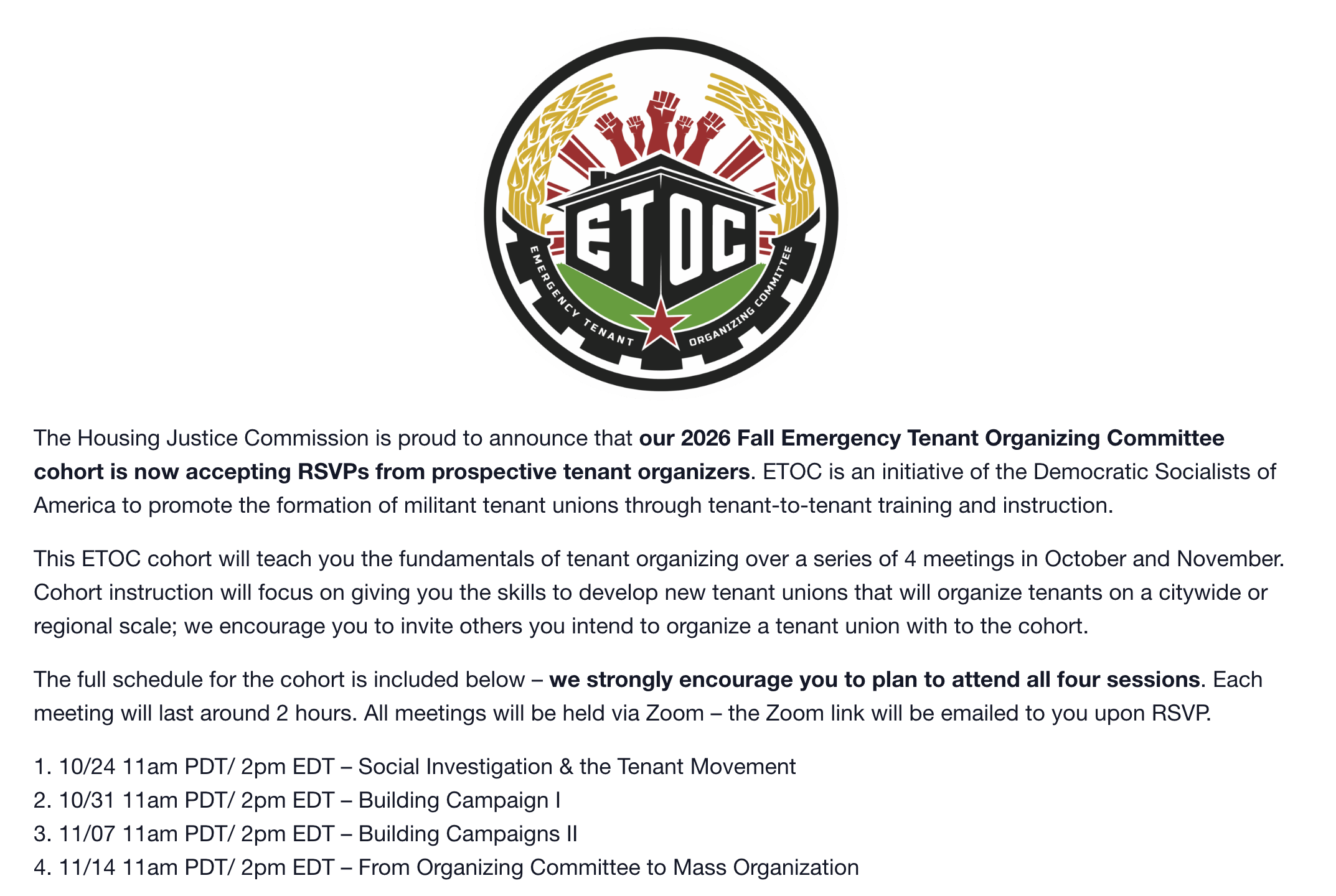
The DSA’s Housing Justice Commission is asking members to apply for its program to train “tenant organizers” and support the formation of “militant tenant unions” rather than mere building-level tenant associations.
The final session of the 2026 Fall Emergency Tenant Organizing Committee is titled “From Organizing Committee to Mass Organization.” Participants in the program will learn how to build new tenant unions on a citywide or regional scale.
So, is this effort about helping renters pay less? Or is it an attempt to build permanent political infrastructure?
The DSA is fairly open about its ambitions. The objective isn’t merely to resolve disputes between tenants and landlords. Critics argue that tenant unions serve a broader purpose: creating durable political organizations that can pursue policy goals long after a particular housing dispute ends.
“Political influence is the goal,” Nicole Huyer, a senior research associate at The Heritage Foundation, told the Daily Signal. Socialists “will use these tenant unions to create sustained constituencies for rent regulation, eviction restrictions, right-to-counsel programs, social housing, collective bargaining with landlords, and similar policies.”
Such organizing could transform “a contractual relationship into permanent class warfare between ‘tenant’ and ‘landlord,’” Huyer warned.
“Tenant organizing is both housing advocacy and movement-building infrastructure,” explained Michael Watson, research director at the Capital Research Center.
“It’s dual-use technology, much as a labor union is dual-use technology: You can use the organized group both to campaign for the specific demands against a specific employer or property owner, and you can use the ‘union’ as a political moving force,” he added.
Why Unions?
Tenant unions aren’t the only non-traditional union the Left uses.
One of the influential groups I expose in The Woketopus is the National Domestic Workers Alliance, a quasi-union that organizes home-care workers. The NDWA played a key role in drafting California’s AB5, a law that cracked down on independent contracting—in a bid to strengthen the power of unions.
The NDWA and other supporters claimed AB5 was all about protecting independent contractors from abusive employers. Democratic Assemblywoman Lorena Gonzalez, the bill’s lead sponsor, let the cat out of the bag when she posted on Twitter in September 2019 using the hashtag “#AB5ForAUnion.” When a Twitter user asked, “what does your hashtag mean?” she replied, “It means we gat AB5—then we organize workers into a union.”
While unions may have been necessary in the Industrial Revolution, when employers herded people into factories and forced them to work long hours in dangerous conditions, they seem more of an anachronism in much of the private sector today. Only 5.9% of private-sector workers belonged to a union last year, compared to about a third (32.9%) of public-sector workers.
America’s large labor unions have a heavily Democratic bent. Not only do unions often bankroll Democratic candidates and leftist causes, but conservative union members have had to fight to make sure their dues don’t go to support the election of candidates they oppose.
FROM MY DESK
📚Reading: “The Minority Rights Revolution” by John Skrentny
Why did the civil rights movement succeed so spectacularly? It’s quite remarkable that Congress, in the 1960s, passed landmark civil rights legislation just a few decades after the Ku Klux Klan’s heyday in the 1920s. Many historians note the struggles of black leaders like Martin Luther King Jr.—and they did play a large role. But Skrentny explains how World War II and the Cold War changed the meaning of civil rights for Americans, and how bureaucrats began constructing our civil rights apparatus. This book helps flesh out that history, and explain why our categories of “minorities” don’t always make sense.
🦷Chewing: Underbrush Remineralizing Gum.
Do you ever see those ads for gum that supposedly helps your teeth rebuild themselves? Well, most of the ads are for brands that are more expensive and less proven than Underbrush. Now, let me be clear—this gum isn’t a replacement for brushing your teeth. But I do think the minerals may help, and I enjoy chewing it.
Unions like the ACLU, AFSCME, and the American Federation of Teachers act as kingmakers in the Democratic Party by making donations and endorsements. As such, the DSA’s interest in unions isn’t just ideological—it’s practical. Democratic Socialists don’t just want to be on the side of workers against management—they want to benefit from the organizational infrastructure unions provide.
The DSA isn’t alone in seeking out tenant unions, however.
Left-leaning foundations have generously funded efforts to organize tenant unions. In June, the Robert Wood Johnson Foundation gave the National Housing Law Project $3,550,000 “to provide core support to the Tenant Union Federation in countering authoritarianism by building the collective capacity of poor and working-class people to practice noncooperation and civil resistance.”
The language of this grant, like the goals of the DSA, highlights the central purpose of this organizing—political power.
The DSA understands something many conservatives still overlook: political figures come and go, but institutions are more likely to endure. Training activists to organize renters isn’t about cutting utility fees. It’s about building a permanent infrastructure for political organizing, in the name of helping the little guy.
Americans shouldn’t fall for it.
This article is an expansion of commentary initially published on The Daily Signal.
Disclosure: This newsletter may contain affiliate links. If you purchase through these links, I may earn a commission at no additional cost to you.